
BWP vs MR Plywood: Which Is Right for Kitchens and Wardrobes?
The plywood inside your kitchen and wardrobes decides how long they last. Here is what MR, BWR and BWP mean, and where each belongs.
In this article
When you look at an interior quote, the plywood grade is easy to miss but it matters more than almost any finish. It decides how your kitchen copes with water and steam, and how your wardrobes hold up through humid monsoons. Here is a plain-English guide.
Use BWP plywood wherever there is water or humidity, especially kitchens and bathroom vanities. MR plywood is meant for dry areas only. We use BWP plywood for all our woodwork and back it with a lifetime warranty on woodwork.
What the plywood grades mean
MR (moisture resistant)
MR plywood is made for dry, indoor use. It is typically bonded with urea-formaldehyde or melamine-urea-formaldehyde resin. It handles normal room humidity but is not designed for prolonged contact with water.
BWR (boiling water resistant)
BWR plywood uses phenol-formaldehyde resin and resists moderate moisture and occasional splashes better than MR. It is covered under IS 303.
BWP (boiling waterproof)
BWP plywood is bonded with phenolic resin and is designed to withstand prolonged exposure to water. Marine-grade BWP plywood is made to IS 710, and the Bureau of Indian Standards has also added a BWP grade to IS 303 for general-purpose plywood.
| MR | BWR | BWP | |
|---|---|---|---|
| Water resistance | Low (dry areas) | Moderate | High |
| Typical resin | Urea or melamine-urea formaldehyde | Phenol formaldehyde | Phenolic |
| Standard | IS 303 (MR grade) | IS 303 | IS 710 (marine) or IS 303 BWP grade |
| Best for | Dry furniture, some wardrobes | Areas with occasional moisture | Kitchens, vanities, utility areas, all-round use |
| Relative cost | Lowest | Medium | Highest |
Why kitchens need BWP plywood
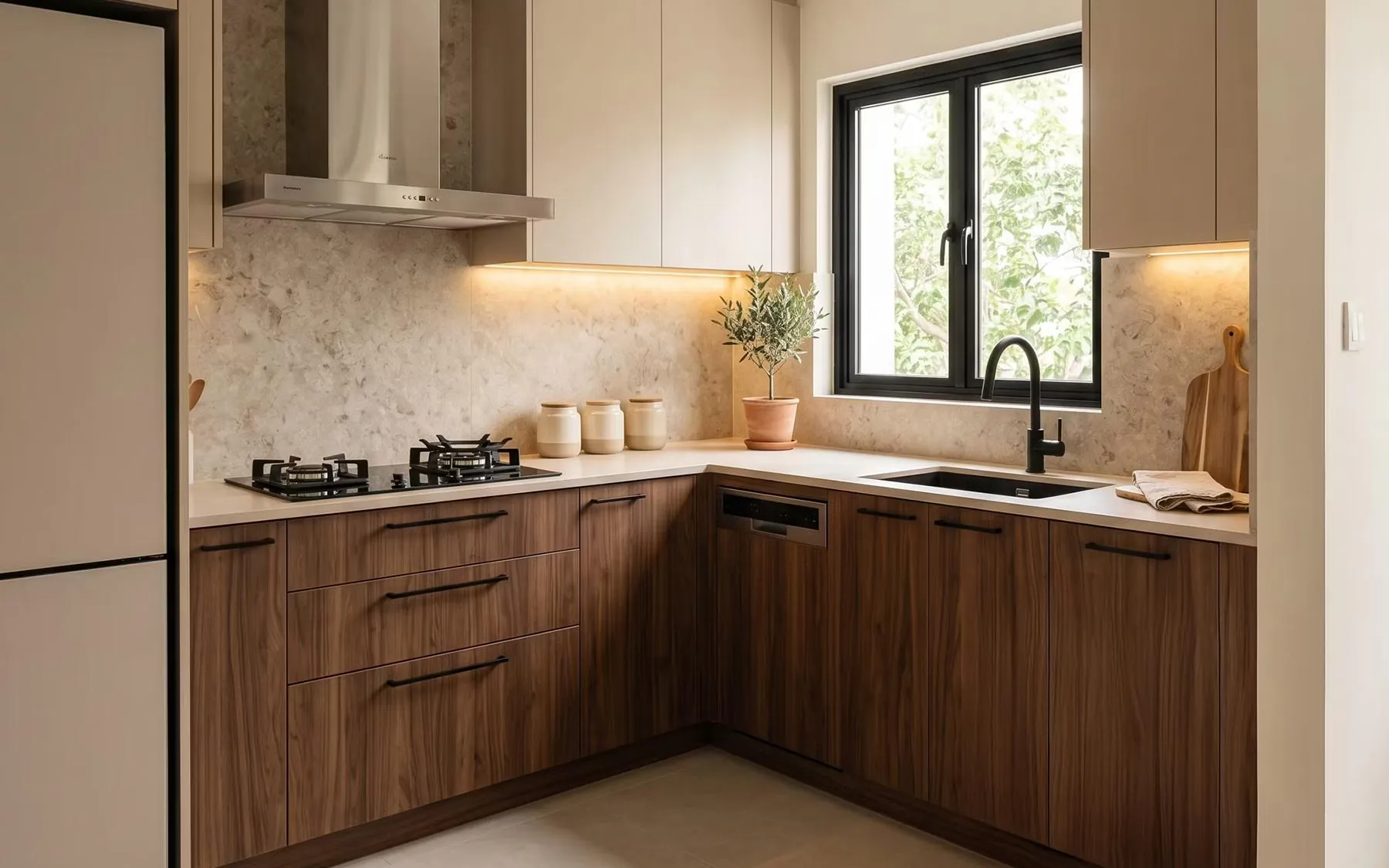
Kitchens face water from the sink, steam from cooking, spills on the floor and regular wet cleaning. Under the sink is the most vulnerable spot. Lower-grade plywood can swell or delaminate when water gets in at the edges, and once that happens the cabinet usually needs replacing.
What about wardrobes?
Wardrobes are in dry rooms, so MR plywood is often used to save cost. The trade-off is less resistance to monsoon humidity, wardrobes on walls that may get damp, and spills. Using BWP throughout means there is no weak spot in the home, which is why it is our standard.
Plywood vs MDF, HDHMR and particle board
MDF and particle board are cheaper engineered boards. They give smooth surfaces for some shutters and loose furniture but generally do not cope well with water. HDHMR is denser and more moisture resistant than MDF. For carcasses in kitchens and wardrobes, good plywood remains the most dependable choice.
How to check the plywood in your interiors
- Look for the marking. Genuine sheets are stamped with the brand, grade and IS standard.
- Check the grade in the quote. It should say BWP (or BWR or MR) for each item, not just “plywood”.
- Ask about thickness. Carcasses and shutters usually use different thicknesses; the quote should list them.
- Get the warranty in writing. We give a lifetime warranty on woodwork and 5 years on hinges and other hardware.
Frequently asked questions
Is BWP plywood worth the extra cost?
For kitchens and any area near water, yes. Replacing a swollen cabinet costs far more than the difference in plywood grade.
Can I use MR plywood for wardrobes?
It is commonly used in dry rooms, but it is less resistant to humidity and spills. We use BWP for all woodwork so there are no weak spots.
What is the difference between BWR and BWP?
Both use phenolic resins, but BWP is designed for prolonged water exposure while BWR handles moderate moisture.
How do I know my contractor used BWP?
Ask for the grade and IS standard in the quote and check the brand and grade stamp on the sheets at site.
Plan Your Home With Us
Tell us your locality and home type. We will call you back to fix a time for the site visit.
- +91 86674 38931
- hello@homeinteriordesign.in
- Kompally, Hyderabad · free site visits across Hyderabad